All Case Studies
Design Harvard Business Publishing • with Wilma Huertas
HBP Collections
A shared component library and set of interaction patterns that let teams ship new learning pathways without rebuilding the same UI from scratch every time.
The Challenge
Without a shared system, every new Collection, a curated pathway of learning content like articles, tasks, and progress tracking, meant designing and building its own version of the same patterns: progress bars, table-of-contents navigation, task cards, completion states. Teams were solving the same interface problems repeatedly instead of building on shared work, which slowed down how quickly new Collections could ship.
Our Approach
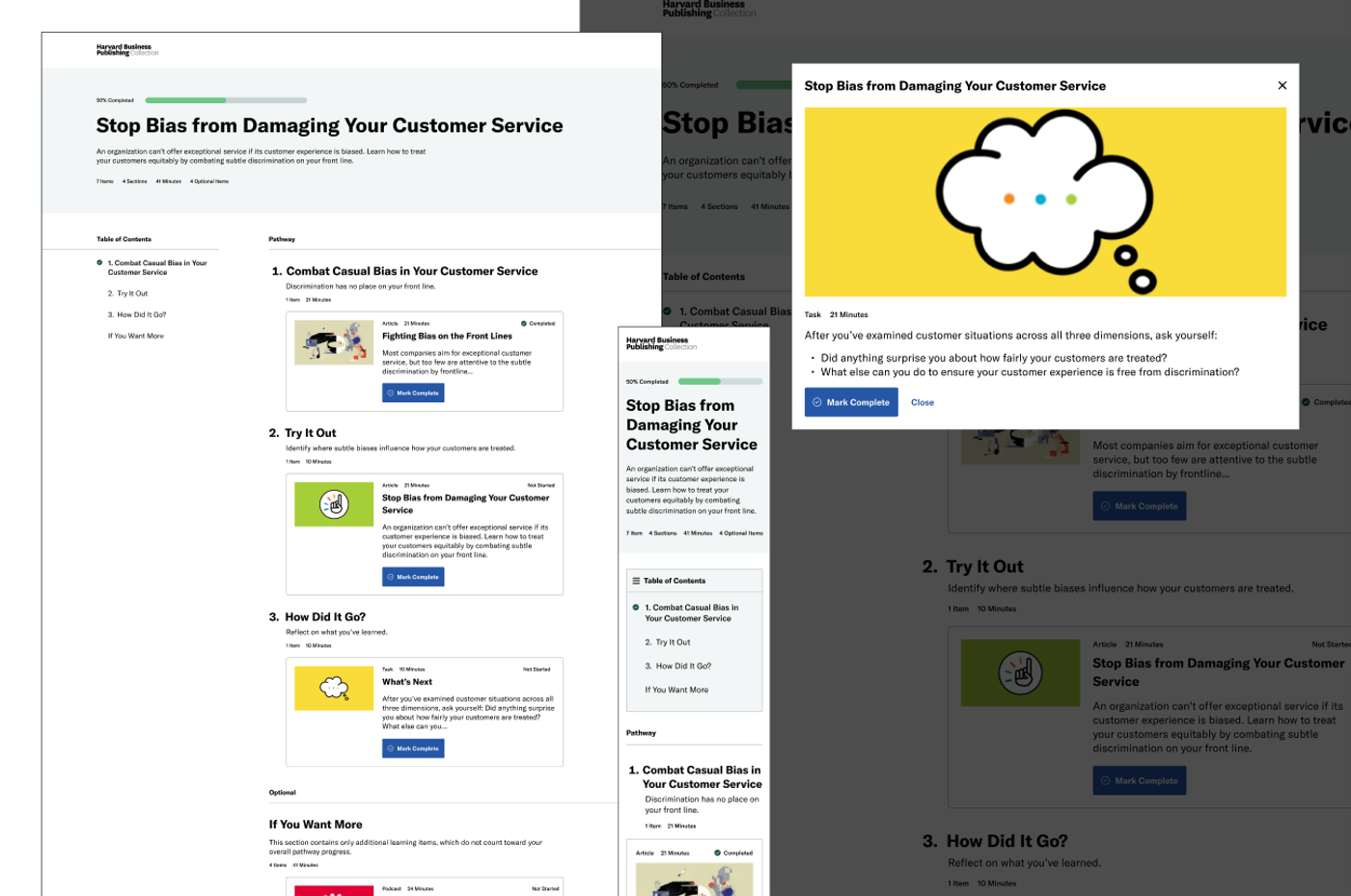
I owned the design system end to end: the component library and the interaction patterns that held it together. That meant defining, once, how progress gets tracked and displayed, how a pathway's table of contents behaves as items are completed, how task cards present an article, video, or exercise alongside its time estimate and status, and how a completion state (a "Mark Complete" action, a checkmark, a modal reflection prompt) behaves consistently everywhere it appears.
A Collection like "Stop Bias from Damaging Your Customer Service" shows the system in practice: a progress bar tracking completion, a persistent table of contents, sequential pathway steps built from the same task-card pattern, and a modal task overlay for reflection prompts, all built from the shared library rather than assembled one-off.
The Solution
With the component library and interaction patterns established, teams could assemble new Collections from existing, tested pieces instead of designing and building each pattern again. That's the direct payoff of a design system: the first Collection is slow because you're building the patterns; every one after it is fast because you're reusing them.
Project Details
- Client
- Harvard Business Publishing
- Lead
- Wilma Huertas
- Service
- Design
Image viewer
Next Case Study
TalentXchange
TalentXchange